Connected Data Products Demo
Presented at the Building Open Connected Scientific Data Products for the Cryosphere hackdays, April 2026.
The problem
You have data files. Lots of them. NetCDF, HDF5, GeoTIFF, sitting on a server or in the cloud. To do anything with them, you download, open, and extract what you need. If someone else wants to build on your work, they download the same files and start over.
It’s not connected, and it’s often times not reproducible.
What if existing files were already Zarr?
Zarr is a cloud-native format designed for partial reads. You can grab one chunk without downloading the whole file. But nobody wants to re-encode petabytes of existing data into a new format.
Virtual Zarr enables performant, cloud-optimized access to archival data formats like NetCDF and HDF5 without duplicating any data.
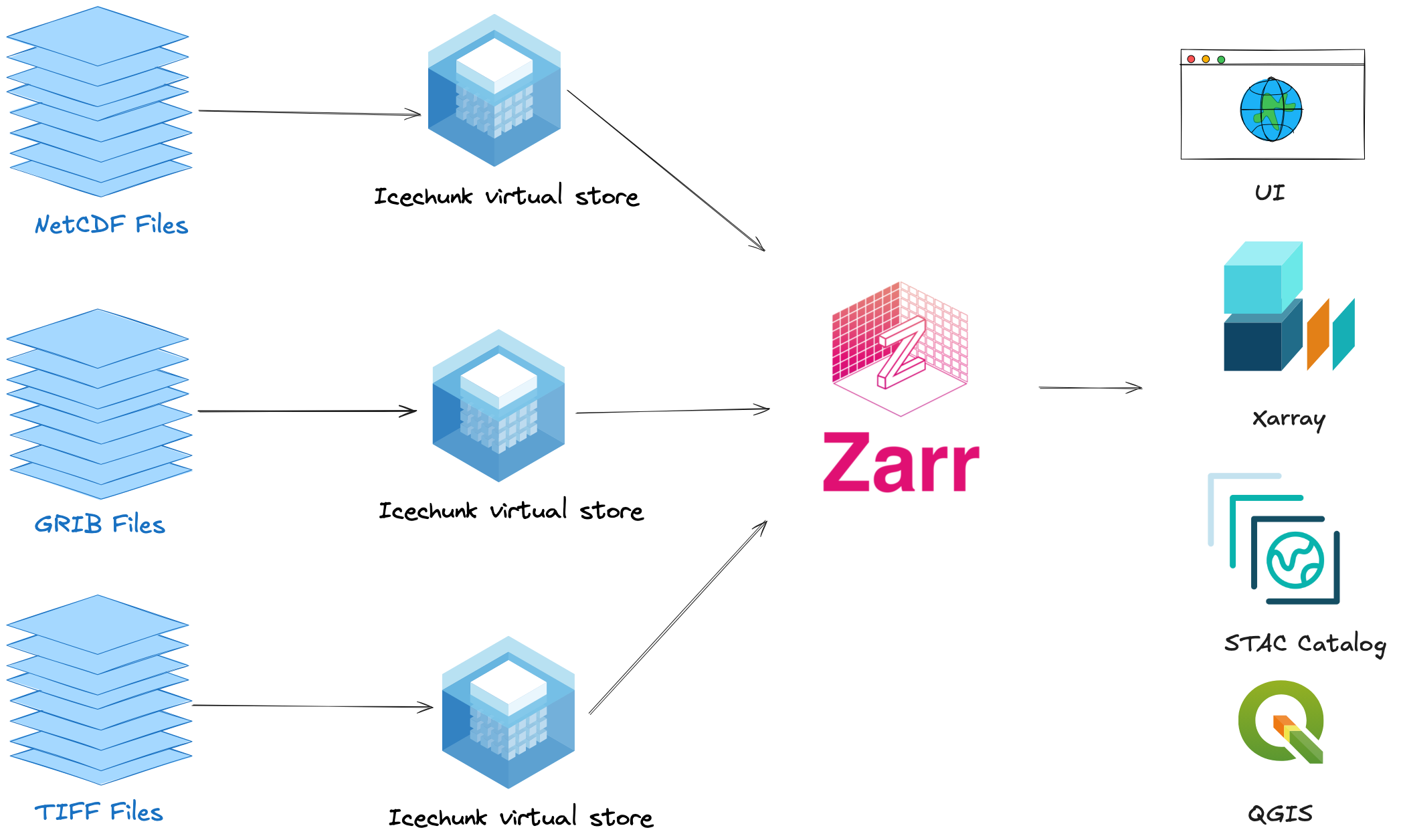
VirtualiZarr reads the metadata from existing files (HDF5, NetCDF, GeoTIFF) and creates a lightweight index: “chunk 0 is at byte offset X in this file, chunk 1 is at byte Y.” The index is tiny. The data stays where it is. This only needs to happen once per file.
Icechunk stores that index in a versioned, git-like repository. You commit it, share it, and anyone can open it with xarray. Every subsequent read goes through the Icechunk store, no re-virtualization needed. When new data arrives, you virtualize just the new files, append, and commit.
No data is copied. The original files stay where they are. Everyone reads from the same virtual store, and only the chunks they need are fetched.
This demo
We apply this pattern to NISAR GUNW (Geocoded Unwrapped Interferogram) data. NISAR is a new SAR mission that measures surface deformation, including ice sheet motion. The demo uses a GUNW granule over New Zealand (chosen because NISAR’s cryosphere products are still in early release), but the workflow applies to any HDF5 dataset.
To explore how NISAR chunk manifests look interactively, see the NISAR Manifest Explorer.
Notebooks
Virtualize NISAR GUNW: Create virtual references via S3 and persist to Icechunk
Query via Icechunk: Open the Icechunk store, extract a spatial subset, and visualize
Query via h5netcdf: Same query the traditional way (baseline comparison)
There is also an HTTPS version of the virtualization notebook that works from anywhere, though Icechunk support for earthaccess HTTPS is still in progress.
Why this matters for hackday projects
If you’re working with archival data this week (HDF5, NetCDF, GeoTIFF), you can use this pattern to:
Make your data product queryable without converting to a new format
Make it shareable by committing virtual references to Icechunk
Make it updatable by appending new data and committing a new snapshot
Make it reproducible by pinning to a specific Icechunk snapshot
Running locally
git clone https://github.com/virtual-zarr/connected-data-products-demo
cd connected-data-products-demo
uv sync
uv run jupyter lab
Requires a NASA Earthdata account (free).
Serving the docs
uv run myst start